
Applied AI delivery · Live multiplayer
Name That Team Member
I was leading a department meeting for about 170 people. I wanted an icebreaker people would enjoy, so I directed AI agents to help me build and test the missing experience.
Why I built it
I wanted people to have fun.
I was leading a department meeting for about 170 people and needed an icebreaker. The audience tools I found could run a poll or ask a multiple-choice question, but they did not create the live, visual experience I wanted people to enjoy together.
I knew the room, the people, and the feeling I wanted. With my software background and AI agents available for implementation, building the missing experience made more sense than forcing the idea into an existing tool.
The experience
One host, a room full of phones, and a shared screen.
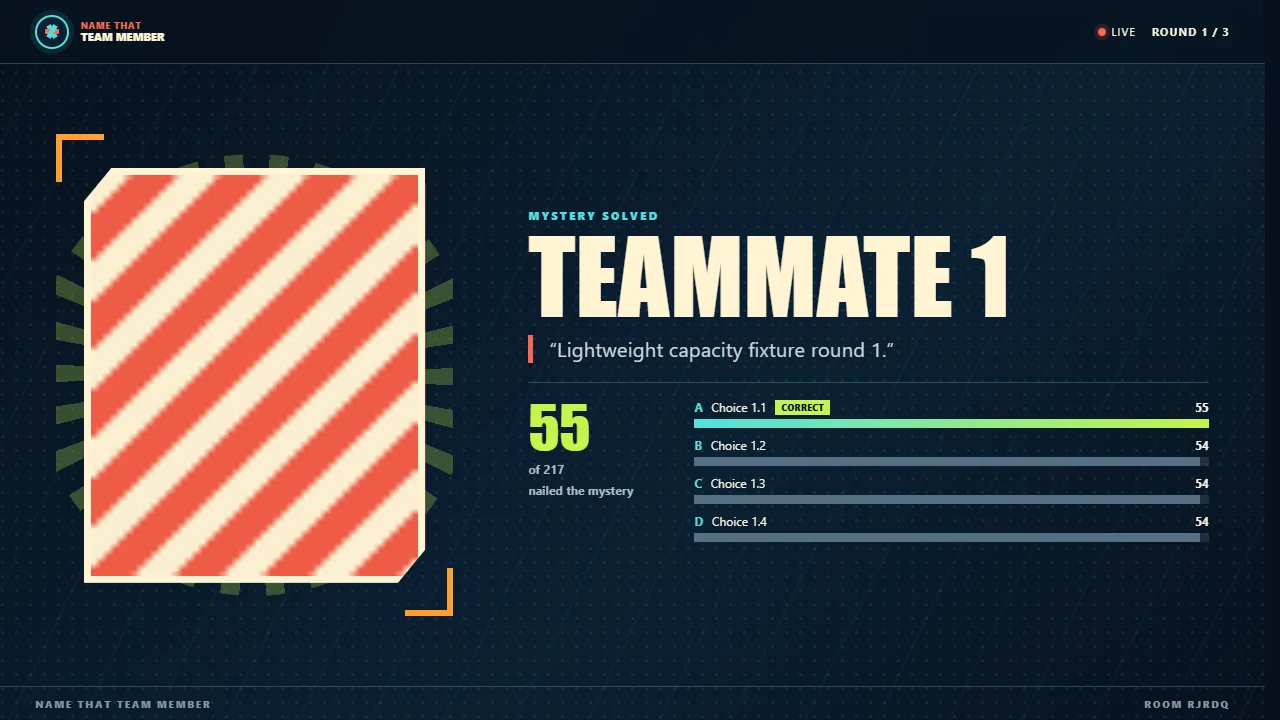
The host creates a room and advances each round. People join in a browser, study a mystery image, and choose the teammate they think it belongs to. Once answers are locked, the host reveals the image and the shared screen updates the scores and leaderboard.
Where AI came in
The first working round came from the first prompt. By the fourth, it was ready for the event.
That did not happen because a short prompt performed magic. I gave the agent the product intent, technical constraints, architecture, acceptance criteria, test expectations, and a clear milestone. The first result completed a working round. Prompts two and three refined the host, phone, and shared-display experience and addressed synchronization, reconnects, timing, scoring, and reliability. Around prompt four, the live version was ready.
AI wrote much of the implementation. I directed the work, checked the evidence, and stayed responsible for how the experience felt in the room.
Four directed passes
From a working round to event ready.
Each pass had a specific milestone and evidence to produce.
Start with one complete round.
I described the people, roles, product intent, architecture, constraints, acceptance criteria, and tests. The result was a complete working round.
Architecture
PostgreSQL stored the room state; realtime events kept clients in sync.
A fresh snapshot lets a late or reconnected browser recover if it misses an event. Host and participant credentials are separate, answers lock on the server, and reveal images stay private until the host advances the round.
AI-directed QA
I did not have a dedicated QA team, so I used an agent to build the technical safety net.
I directed the agent to test joins, late arrivals, reconnects, synchronization, scoring, timing, answer locking, browser behavior, regressions, authorization, media loading, and acceptance criteria. The separate load run stepped through 5, 25, 100, 175, and 225 simulated clients so I could see how response time and scoring changed as the room grew.
What shipped
The experience was ready for the approximately 170-person meeting.
The finished product ran as three responsive browser experiences with host control, synchronized rounds, private reveals, scoring, and a leaderboard. At 225 simulated clients, personalized score and rank refresh took longer than I wanted. That gave me a useful limit to watch without affecting the meeting it was built for.